
You're a small team building a SaaS product. A handful of developers, maybe a PM. You're eyeing a new market, or you've decided it's time to support your customers' languages to cover market demand better. The enterprise playbook used to say: buy a Translation Management System, hire a localization manager, set up workflows with translation agencies. But you're a small team and you feel like there must be a better way.
I've worked on a few localized products and talked to many teams shipping in multiple languages. This post goes through how you can handle localization without dedicated localization resources.
The typical SaaS translation workflow
The process can look something like this: design happens in one language, the feature gets built, reviewed, QA'd. Then, almost as an afterthought, someone collects all the new strings and sends them off for translation. Maybe it's a Slack channel where internal people help out. Maybe it's a spreadsheet that goes to a translation agency. Maybe someone just pastes things into ChatGPT.
The translators, often someone from support or customer success rather than a dedicated translator, get a list of keys with minimal context. They do their best. Some languages come back quickly, others depend on whether the right person is available that day.
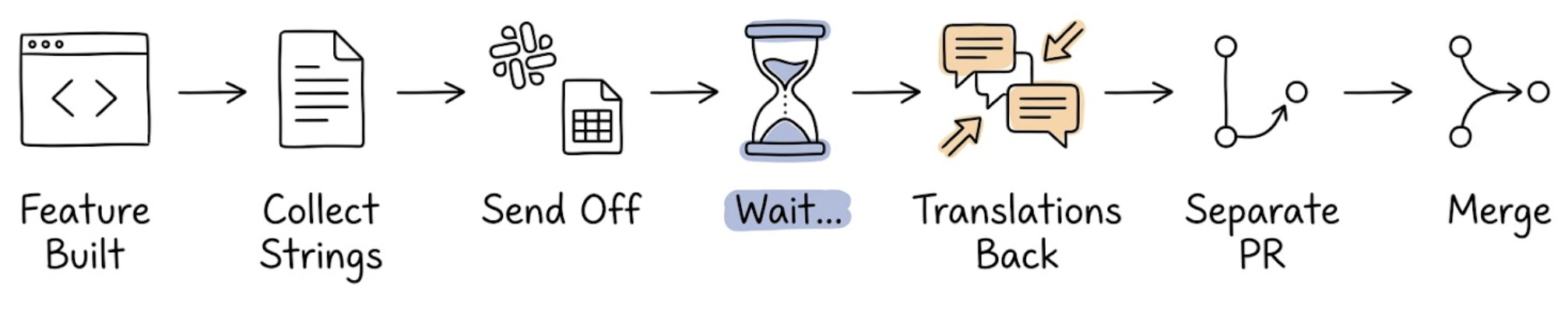
The results can vary from time to time. Sometimes translations arrive late, once in a while a language or two are missing because someone is on holiday, and there's usually a bunch of back and forth before everything is ready.
The two biggest problems
Translations block releases
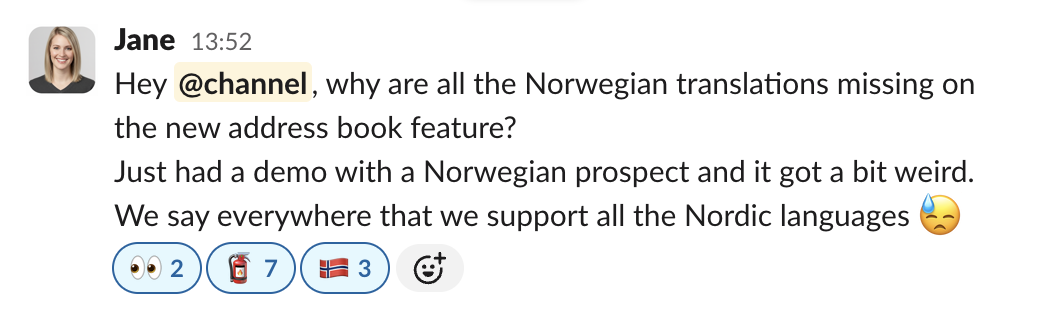
Consistency drifts quietly
Different people translate at different times with different amounts of context. The same term gets translated three different ways across your product. Your settings page says Instrumentpanel,
your navigation says Kontrollpanel,
and your onboarding says Översikt.
All valid Swedish translations of Dashboard.
All completely inconsistent.
This gets worse with LLMs. They're good at translation, but they vary from call to call. Without a glossary, style guide, and examples, you get a product that sounds like it was written by a different person on every page.
A better approach to SaaS localization
Here's what I'd tell a small team starting out with localization today.
Define your brand voice early
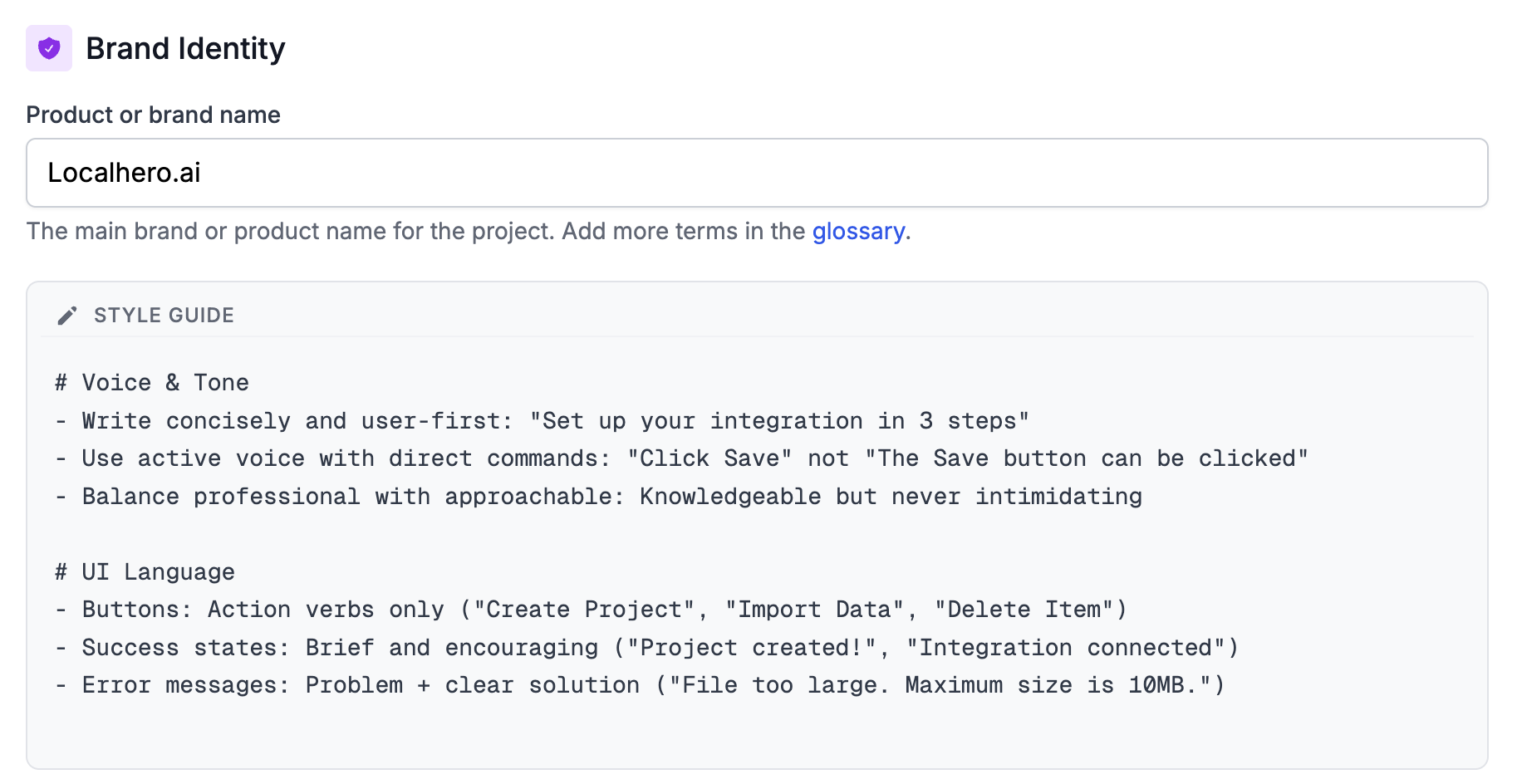
In my experience, this is the highest-leverage thing you can do. Before you translate a single string, decide: are you formal or casual? Do you use du
or ni
in Swedish? Du
or Sie
in German? What terms should never be translated? What's your product's personality?
This doesn't need to be a 20-page document. A few bullet points is enough. Same with a glossary, just add the terms that matter most: your product name, key features, anything that should stay untranslated. Having this written down means everyone, human or AI, translates with the same voice.
Automate first, perfect later
The instinct is to have every translation reviewed before it ships. That sounds responsible, but in practice it means translations become a bottleneck. Someone has to review, someone has to approve, someone has to merge. For a small team, that process kills velocity.
A better approach: automate the translations and make it easy to adjust later. Ship with good enough
and fix things if someone notices something that is off. This sounds scary, but consider the alternative: holding back a feature for days because one translation isn't perfect. Your users would rather have the feature with a slightly imperfect translation than not have it at all.
In my experience, AI translation with proper context, a glossary, and a style guide gets you to maybe 90-95% quality. The remaining 5-10% can be caught and fixed incrementally as needed. The idea is to make it a continuous process. It's not like human translators never make mistakes either.
Make translations part of the PR, not a separate step
When translations happen automatically as code changes, in the same pull request, they become just another thing to review before merging. Not a separate workflow, not a separate PR, not a separate tool.
This also solves the context problem. The translator (human or AI) can see what changed, why, and how it fits into the feature. Not just a list of isolated keys. Localhero.ai gives you an easy-to-share page for each PR it has translated, where you can review and tweak translations without looking at code or JSON diffs.
Feed improvements back into the system
Every translation your team adjusts, every glossary term you add, every style guide tweak, should feed back into the system. The next time a similar string comes up, the translation should be better because of what you decided last time.
I think this is what separates a process that stays the same quality forever from one that actually improves. After a few months, your system should know how your product speaks.
Do you need a translation management system?
The default answer in the localization industry is yes. But I think for most small teams, a traditional Translation Management System can be overkill.
A TMS like Lokalise, Phrase, or Crowdin is built for a world where you have dedicated localization managers, professional translators, complex approval workflows, and hundreds of thousands of strings. The setup, maintenance, and monthly cost (Lokalise starts at $144/month, Phrase's team plans around $1,200/month) assume someone's job is to manage it and the projects around it. For a dev team shipping product strings, that's usually more machinery than you need.
If you're a team where nobody's job title includes localization,
you need something different. You need translations to happen as part of your existing workflow, not in a separate tool that someone has to remember to check.
The question isn't which TMS should we buy?
It's how do we keep shipping fast without translations slowing us down?
We write a bit more about this in SaaS Localization Without a TMS, as well as thoughts on when a TMS actually makes sense.
What does all this cost?
When you start thinking about localization, you probably quickly start doing some back-of-the-napkin calculations. The raw translation cost is actually quite low these days. What you're really paying for with specialized tooling is everything around the translation: glossary enforcement, quality checks, CI integration, review workflows, and consistency that improves over time. A good tool gives your team a way to work with translations directly instead of creating tickets, chasing people in Slack, or context-switching between systems. That's where the developer hours go, and that's what good tooling should take off your plate. We've written a bit more on the topic in What SaaS Localization Actually Costs.
The practical checklist
If you're a small team about to add more languages, here's what I'd focus on:
- Write down your brand voice in a few bullet points. Formal/casual, terms to keep untranslated, tone.
- Pick an i18n library that fits your stack.
react-i18nextornext-intlfor React, Rails' built-inI18n, Django'sgettext. Use whatever file format the library expects (JSON, YAML, PO). Don't fight your framework. - Automate translations. Whether it's a script, a GitHub Action, or a service like Localhero.ai. The goal is zero manual work for the default case.
- Make review easy for non-developers. Your PM or content person shouldn't need to read JSON diffs. Give them a UI.
- Get the process rolling. Ship, get feedback, improve. Don't let perfect be the enemy of translated.
- Build a glossary as you go. Every time someone corrects a translation, add the term. It compounds.
You've got better things to ship
Localization for a small team doesn't have to be complicated. The goal is to make translations something that just works
with minimal effort, something that happens automatically, gets better over time, and doesn't require anyone to think about it day to day.
The thing is, your users don't care how your translations get made. They care that your product feels like it was built for them. Focus on that, and keep shipping.
This is what I'm building Localhero.ai to solve. Automated translations that learn how your product speaks, integrated into your dev workflow, for teams that don't have a localization department. Try it free or check out our guide to setting up style guides and glossaries to get started.
FAQ
How does a small SaaS team set up translation management?
Keep the translation files in your repo and automate around them. Pick the locale format your framework already uses, wire translation into CI so it runs on pull requests, and write down your product nouns as a glossary before the first translation run. The risk worth watching is adopting a platform that becomes the source of truth: you then have two systems to keep in step, and somebody has to own that sync.
Do we need a dedicated localization person?
It depends on the work, not the size of the company. Plenty of established teams ship many languages without one. The job being done is coordination, and coordination is what automation removes. Once new strings translate on the pull request that introduced them, the recurring work is review rather than chasing files. With Localhero.ai a product team gets on-brand translations automatically, from a glossary and style guide that learn how your product speaks, which keeps consistency from depending on one person holding it in their head. A dedicated role earns its keep when marketing sites, legal copy and in-app content all run in many languages at once and someone needs to own that whole surface.
How many languages should we launch with?
Fewer than you think, chosen from evidence. Look at where signups already come from and where support requests arrive in another language. Two or three languages you actually support well beat eight that go stale. Every language you add is a surface you keep current on every release, and it needs support coverage when a customer writes in. Automation makes the ongoing updates cheap; the initial backfill and QA for a new language still cost real time.
Can we do this without heavy developer involvement?
Setting it up is quick, and after that it runs itself. If your code is on GitHub, the Localhero.ai GitHub App analyses the repository, detects your framework, translation format and file locations, and opens a pull request with the workflow and config already written. A developer reviews and merges that PR, which is the natural place for them to be involved, and there is no config to hand-write. From then on translations happen on every pull request without anyone starting them, and non-developers review and edit them in the dashboard without touching code or git. The engineering time is one merged pull request, not an integration project.
Further reading
The SaaS localization cluster:
- SaaS Localization Without a TMS - when you don't need a Translation Management System
- What SaaS Localization Actually Costs - real cost breakdowns at every stage of growth
- How to Localize Your Rails or React SaaS End-to-End - the full workflow beyond the i18n basics
- Automate SaaS Localization in Your CI Pipeline - continuous localization for developer-driven teams
Related:
- How to Automate i18n Translations with GitHub Actions - set up automated translations in your CI pipeline
- Translating JSON and YAML locale files in CI without a TMS - the working CI pattern, with code
- How to pick a translation setup for your stack - a decision aid by stack and team shape
- Translating your i18n files with Claude Code or Cursor - making coding agents translation-aware
- How to Automate Your Translation Workflow - in-house, agency, and AI compared