
For most teams, translations are something releases wait on. Kundo changed that, now translations happen automatically, as part of how they ship, without holding things up or sacrificing quality.
The translation itself isn't really the hard part anymore, you can get LLMs to handle that well with the right context and tooling. The hard part is everything around it: keeping translations in sync as strings change, getting it out of the release path, and not having to build and maintain that pipeline yourself. And keeping the quality up, consistent terminology, the right tone, your brand voice holding across every language, not just text that's technically correct.
While I was building Localhero, I was also doing some consulting at Kundo, so I had a foot in both camps. Their translation process came up as something they wanted to improve, and when I showed them what I'd been building, it turned out to be what they needed. They liked the automation and how easy it was to tweak translations, and we got it set up across their platform. This is the story of that migration.
The problem: translations were slowing down releases
Kundo is a Swedish customer service platform, built for the AI era, that combines ticket handling and self-service in one solution. It's used by 500+ organizations, and it's a fair bit of product across several repos, translated from Swedish into eight more languages: English, German, Dutch, Danish, Spanish, Polish, Finnish and Norwegian.
The translation flow had grown organically over more than a decade. A pretty standard setup: a TMS (Transifex, in their case) with its limitations (more built for project management than for a dev team shipping continuously), and a translation agency doing the actual translations. There were CLI commands to push new strings to the TMS, and translations from the agency were ordered via email. The kind of choices and workarounds that compound over the years into a process with some friction and delays. None of it was broken. There were just quite a few steps, and steps are where releases go to wait and small mistakes slip in.
Here's how Ted Bäckström, Tech Lead at Kundo, described it:
Translations have always caused friction at Kundo. It costs money, sometimes things go wrong, it's easy to miss something, and above all, it takes time. Sometimes it delays our releases by several days just to wait for translations.
The migration
Kundo's platform is a mix of Django, Elixir and React, so this had to work across a few different stacks. The setup was basically like this in the repos:
- Run
localhero initto set up the repo + add the Localhero GitHub Action. - Import the existing translations so nothing was lost.
- Translate anything missing to get full coverage everywhere.
- Set up the style guide and glossary to get the best results from the AI translations.
After that, translations just happen in the normal pull request flow. Localhero picks up new and changed strings, translates them, and adds the result straight to the PR, the same translate-on-every-PR pattern we use ourselves:
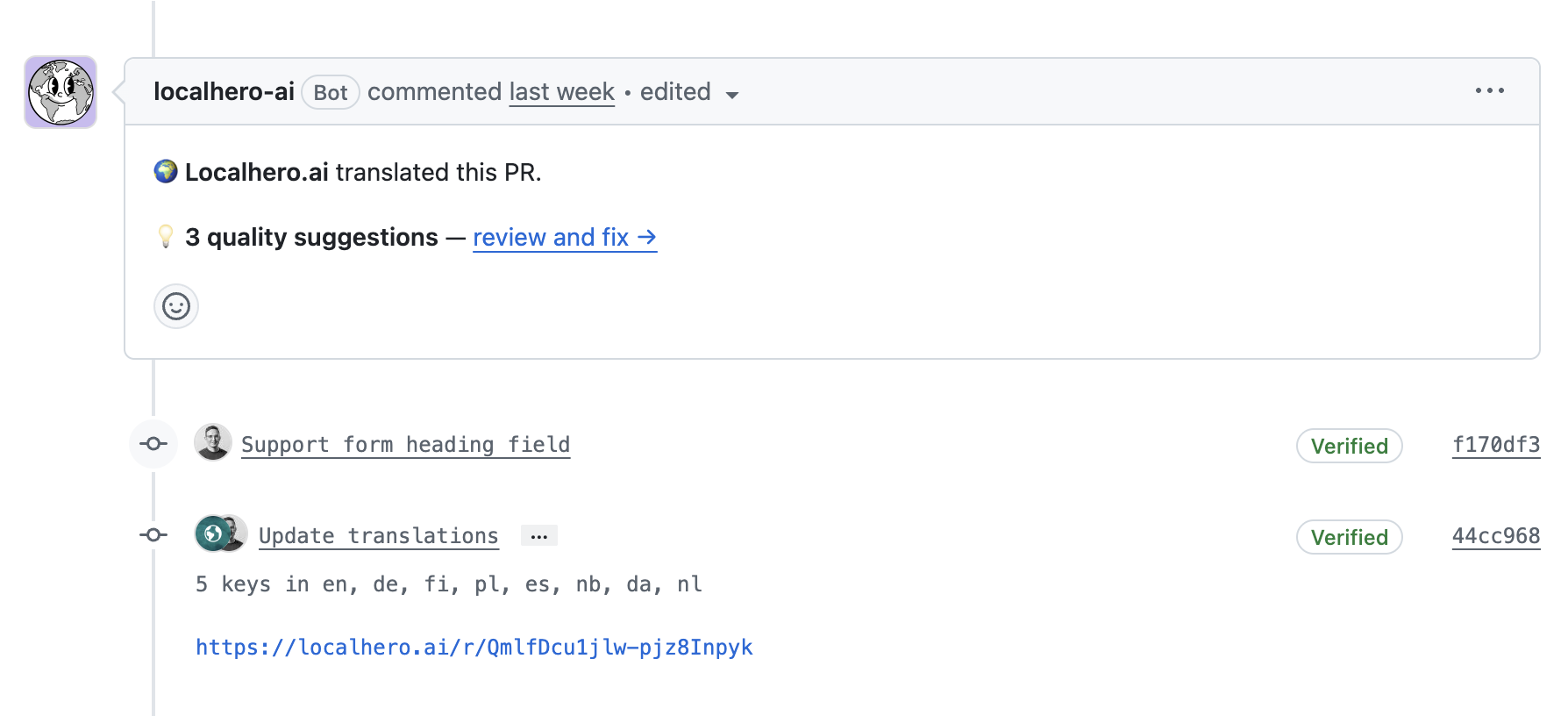
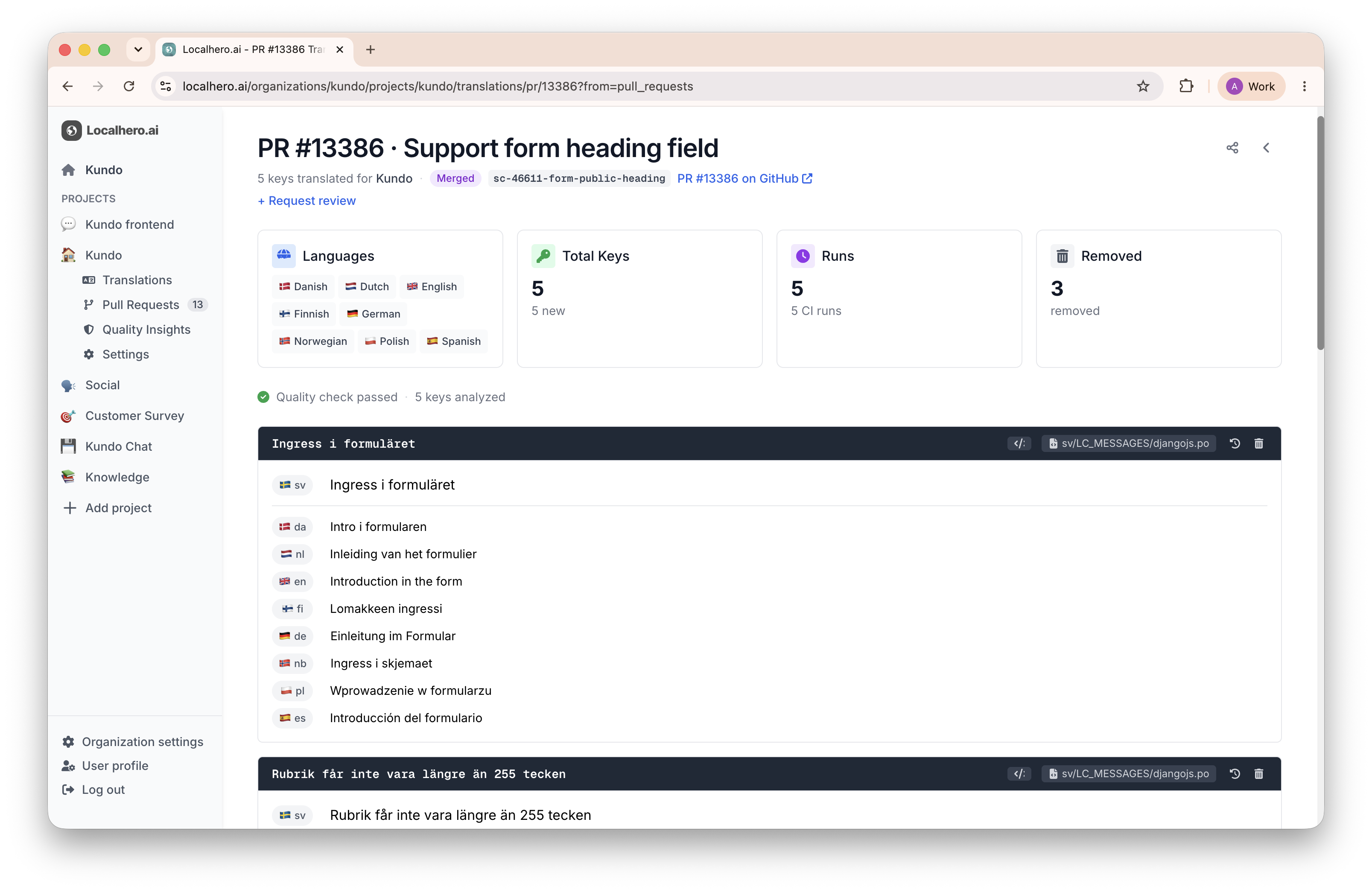
You also get a fuller view of each PR in Localhero, every language, every key, and the quality checks in one place:
One important part of getting the translations right was the style guide and glossary. A PM, the CPO and I went through what Kundo already had and captured the tone they wanted, along with the special terms that need to stay consistent across languages. New glossary items get added as they come up. That's what keeps the automated translations on-brand instead of just technically correct. (We have a separate post on setting up a style guide and glossary if you want to go deeper.)
We removed the old TMS tooling, updated some of the existing commands so things stayed familiar for developers, and cleaned up the translation data along the way. It was a joint effort with the Kundo team, which also made it easy to fit the setup to how they already worked.
What changed
Translations are no longer something you wait for. The wins, in order of what mattered to them:
- Releases stay on track. Translations happen automatically as PRs are created, so the translations are always up to date.
- The team keeps control of quality. AI does the first pass, and it's easy to review and adjust the wording when needed. Even new source strings get checked as they're added.
- The language stays consistent. The glossary and style guide keep special terms and tone the same everywhere, across every language and every repo, instead of drifting over time.
- Cost takes care of itself. Less manual coordination, no tooling to maintain.
The translations show up across all of Kundo's products, from the support forms to the AI chat:
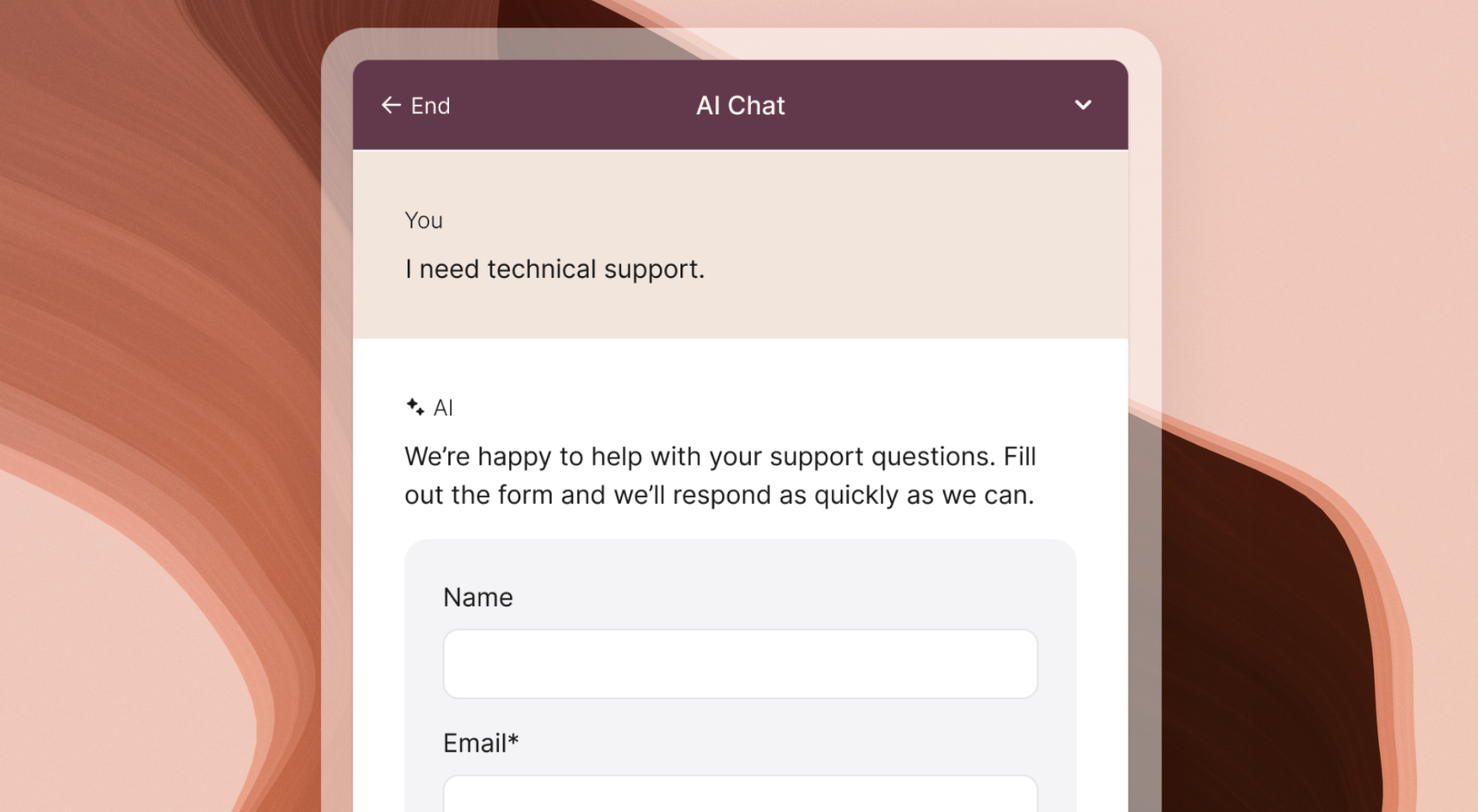
It's now rolled out across all of Kundo's services. I'd rather let them say it than grade my own work:
localhero.ai has improved how we work across all these areas. Instant translations, at a better price, plus tools to refine every piece of copy in our platform. It's rolled out across all our services now and it feels great to have in place! 🚀
— Ted Bäckström, Tech Lead at Kundo
Getting translations off your release path
Most teams that have been shipping for a while end up with a translation setup like this: a TMS, an agency, some scripts to tie it together. It's a perfectly reasonable setup, and for a long time it was the best option available. What's changed is that you can now get good translations automatically, with the workflow built around how a product team actually ships. (If you're weighing the options, we wrote about how to choose a translation setup separately.)
If that sounds like your setup, it might be worth a look. Translations don't have to slow down your releases, and you don't have to build and maintain something homegrown to get there.
Want help automating your localization? Get in touch, I'm happy to take a look at your setup and show you what it'd look like for your stack. Or just try Localhero and set it up yourself.
FAQ
Why did Kundo move off Transifex and a translation agency? Not because anything was broken. The setup had grown over more than a decade and worked: a TMS to hold the strings, an agency doing the translations, CLI commands and email to connect the two. The cost was time. Every step was a place for a release to wait. Their tech lead Ted Bäckström put it plainly: translations sometimes delayed releases by several days. A TMS is built around project management for translators. Kundo is a dev team shipping continuously. The tool and the way they work were pulling in different directions.
How long does it take to migrate from a TMS to automated translations?
The per-repo setup is four steps: run localhero init to configure the repo and add the GitHub Action, import the existing translations so nothing is lost, translate whatever is missing to reach full coverage, then set up the style guide and glossary. Kundo's platform spans Django, Elixir and React across several repos, which meant repeating it per repo. We removed the old TMS tooling and cleaned up translation data as we went. In my experience the technical part comes together quickly. What takes longer (and pays off more) is the glossary and tone work itself. That involves getting decisions out of people's heads.
Does migrating mean losing existing translations? No. This is worth checking before you commit to any tool. When you import into Localhero.ai, existing translations come across as-is and a key that already has content is never overwritten by AI. For Kundo that mattered a lot: nine languages of copy refined over a decade, much of it by professional translators. Import first, then translate only the gaps. Already-translated keys cost no credits. The imported strings also seed the style guide and glossary. The work your old process produced becomes the reference for the new one.
How does a nine-language team keep quality up without a translation agency? By moving human attention from doing the translation to steering it. AI does the first pass on every PR, quality checks run on the result, then the team reviews and adjusts wording where it matters. The part that keeps it on-brand rather than merely correct is the glossary and style guide. At Kundo a PM, the CPO and I went through the tone they wanted and the terms that have to stay consistent. New glossary entries get added as they come up. Reviewers edit in the Localhero.ai dashboard and their changes sync back to the pull request as a commit. A native speaker who doesn't use git can still have the final say.
Does this work across multiple repos and different stacks?
Yes, that was the requirement here. Kundo runs Django, Elixir and React, which means gettext .po files and JSON catalogs in different repos with different conventions. Each repo gets its own configuration and GitHub Action. Glossary terms can live at the organization level, which keeps terminology consistent across all of them instead of drifting per repo. That drift is the failure mode when each team picks its own words for the same feature.
What actually changed for the team day to day? Releases stopped waiting on translations, since strings are translated as PRs are created rather than collected and sent out. Quality stayed with the team rather than with an external vendor. Even new source strings get checked as they're added. Terminology and tone hold across every language and every repo instead of drifting. And the coordination work mostly disappeared, no ordering translations by email, no tooling to maintain between two systems of record.